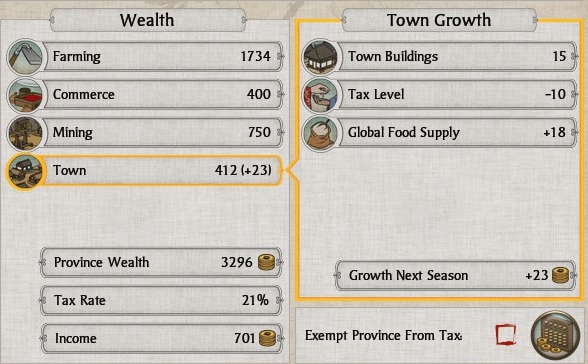
Taxing a Province Taxing is Province wide in Rome 2. You either tax all cities/towns in a province or none at all. Check out the self-proclaimed Best Guide for Rome 2! Total War: Rome 2 - Beginner's Guide by Dark Side Total War: Rome 2 - Guide to Guides by Kurkistan. Below you'll find two sample Roman provinces: Italy focused on recruiting new troops and Magna Graecia generating high income. In the first case the expansion is very easy: you have to take care of feeding people (farms in Neapolis and Velathri - marked in green, settlement in Neapolis - orange) and public order (yellow school of gladiators being built in Rome).

Memphis
Rome II Politics Overview
When you select a faction, you also take the reins of the ruling party or family within its political system. Your faction leader is the head of that party. Many characters in your campaign contribute their gravitas to your party’s political power within your faction. This in turn increases the area of influence your party has throughout your provinces. However, not all other parties will sit idle and watch you rule, for they have their own agenda and aspirations. You can interact with any character involved in politics in the Faction Summary tab by promoting them, using underhanded methods such as bribery and embezzlement, adopting them into your family or even taking aggressive action against them.
By carefully managing characters of political importance and engaging in the various political actions available to you, it is possible to establish a firm grip upon the ruling power in your faction. Loyalty is the key – your goal is to keep other parties happy and loyal to your cause, otherwise they will cause problems in their area of influence. Insurrection builds and if a party’s loyalty is too low, it can cause them to secede and declare independence. The choices you make during your campaign affect the influence that each party possesses. This includes military and civil choices that might not seem directly political, such as which generals to appoint, which technologies are researched and how you manage your economy.

There is no single approach; political non-involvement (in other words, letting the situation unfold on its own while concentrating on civil and military matters) is not necessarily a bad thing, at least in the short term. However, in the long term, inaction will likely result in parties gaining or losing influence excessively without your knowledge. A politically active player must maintain their rule for as long as possible, but other parties will eventually decide to secede and oppose the established order. When a secession occurs, all existing generals and admirals in the opposing party will defect – along with their forces – into a new enemy faction, whose sole purpose is defeating you. Players who choose not to pay attention to influence levels run the risk of this occurring when they least expect it. On the other hand, a party’s loyalty can be diminished intentionally and they can be provoked into breaking off, only to be stamped out by your prepared forces.
Total War: Rome 2 Most Overpowered Builds Guide | SegmentNext
Civil war can occur multiple times in a campaign and sometimes that will be the only way to deal with an intrepid party, but it will be easy to crush them when you are the one who causes their secession. See below for further details.