| Description | Type | OS | Version | Date |
|---|---|---|---|---|
| Intel® SSD Data Center Tool (Intel® SSD DCT) The Intel® SSD Data Center Tool (Intel® SSD DCT) 3.0.27 is a management and firmware update tool for Intel® SSD Data Center Family products using SATA and PCIe* NVMe* drivers. | Software | Windows 10, 32-bit* Windows 10, 64-bit* Windows 8.1, 32-bit* 25 more | 3.0.27 Latest | 12/2/2020 |
| Intel® Memory and Storage Tool CLI (Command-Line Interface) The Intel® Memory and Storage Tool (Intel® MAS) is a drive management CLI tool for Intel® SSDs and Intel® Optane™ Memory devices, supported on Windows*, Linux*, and ESXi*. | Software | Windows 10, 32-bit* Windows 10, 64-bit* Windows 8.1, 32-bit* 21 more | 1.4 Latest | 11/23/2020 |
| Intel® Memory and Storage Tool (GUI) The Intel® Memory and Storage Tool (Intel® MAS) is a drive management tool for Intel® SSDs and Intel® Optane™ Memory devices, supported on Windows* (1.4). | Software | Windows 10, 32-bit* Windows 10, 64-bit* Windows 8.1, 32-bit* 5 more | 1.4 Latest | 11/23/2020 |
| Intel® Solid State Drive Toolbox Intel® Solid State Drive Toolbox version 3.5.15 is a drive management software that allows you to view SSD information, including firmware version, drive health, and more. | Software | Windows 10, 32-bit* Windows 10, 64-bit* Windows 8.1, 32-bit* 8 more | 3.5.15 Latest | 10/23/2020 |
| Datacenter NVMe* Microsoft Windows* Drivers for Intel® SSDs This download record installs version 5.1.0.1003 of the Intel® SSD Data Center Family for NVMe* drivers. | Driver | Windows 10* Windows 8.1* Windows 8* 4 more | 5.1.0.1003 Latest | 10/23/2020 |
| Client NVMe* Microsoft Windows* Drivers for Intel® SSDs Intel® NVMe* driver 5.1.0.1003 supports the Client Intel® SSD's based on PCIe* NVMe*. | Driver | Windows 10, 32-bit* Windows 10, 64-bit* Windows 8.1, 32-bit* 3 more | 5.1.0.1003 Latest | 10/23/2020 |
| Intel® RSTCLI Pro for Intel® Optane™ Memory The Intel® RST CLI Pro utility can be used to perform basic acceleration operations on Intel® Optane memory capable systems. | Software | Windows 10, 64-bit* | 18.0.1.1138 Latest | 10/15/2020 |
| Intel® Rapid Storage Technology Driver Installation Software with Intel® Optane™ Memory The Intel® Rapid Storage Technology (Intel® RST) Floppy Driver (18.0.1.1138) supports the configuration and enabling of system acceleration with Intel® Optane™ memory and maintenance of RAID 0/1/5/10. | Driver | Windows 10, 64-bit* Windows Server 2016* | 18.0.1.1138 Latest | 10/15/2020 |
| Intel® SSD Firmware Update Tool This download record installs version 3.0.10 of the Intel® SSD Firmware Update Tool. | Firmware | OS Independent | 3.0.10 Latest | 7/20/2020 |
| Intel® Rapid Storage Technology (Intel® RST) User Interface and Driver The Intel® Rapid Storage Technology (Intel® RST) Driver (16.8.3.1003) supports the configuration and enabling of system acceleration with Intel® Optane™ Memory and maintenance of RAID 0/1/5/10. | Driver | Windows 10, 64-bit* Windows Server 2016* | 16.8.3.1003 Latest | 7/2/2020 |
| Intel® Optane™ Memory User Interface and Driver for System Acceleration The Intel® Optane™ Memory UI is specifically designed and optimized to support system acceleration with Intel® Optane™ memory modules. (16.8.3.1003) | Driver | Windows 10, 64-bit* | 16.8.3.1003 Latest | 7/2/2019 |
| Intel® Volume Management Device (Intel® VMD) ESXi Tools These utilities are for Intel® Volume Management Device (Intel® VMD) driver version 1.4 and newer. | Software | VMware* | 1.4 and Newer Latest | 5/22/2019 |
| Intel® SSD Data Center Tool - Intel® SSD 910 Series The Intel® SSD Data Center Tool is drive management software for the Intel® SSD 910 Series. | Software | Windows 7* Windows Server 2008 R2* Windows Server 2003* 3 more | 1.1 Latest | 7/25/2013 |
Sd Host Adapter Driver Windows 10 64-bit
-->Intel Sd Host Controller Driver for Windows 7 32 bit, Windows 7 64 bit, Windows 10, 8, XP. Uploaded on 3/3/2019, downloaded 3499 times, receiving a 83/100 rating by 1722 users. No newer drivers than Windows 8.1 on the PowerSpec Support Downloads web page here. Choose the SD device in Device Manager reached by right clicking the Start button, On Driver tab choose Update Driver, then Automatic. If no newer driver found, next try the Roll Back driver button. If unavailable try Uninstall button, restart PC to reinstall.

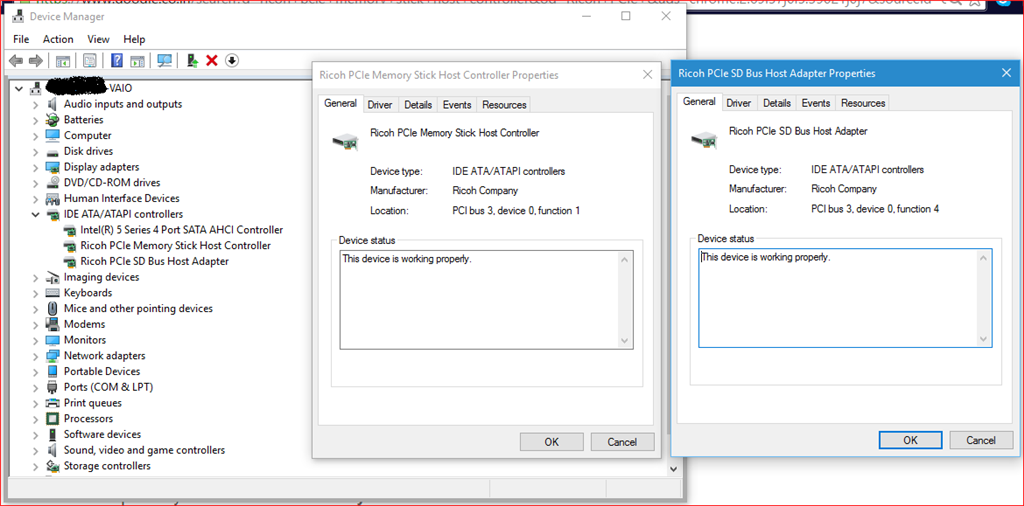
- Operating System: Microsoft Windows 10 (64-bit) Hi, I never tested if the csd card reader worked, and now that I need it, I realized it is not working, so I checked the device manager and noticed that the sd card driver isn't there, or at least I guess it isn't.
- Download Ricoh SD Bus Host Adapter for Windows to sDHost driver. Download Ricoh SD Bus Host Adapter for Windows to sDHost driver. Join or Sign In. Sign in to add and modify your software.
- Intel SD Host Controller - Driver Download. Vendor: Intel. Windows 10 64-Bit Driver. Total Driver Versions: 15. Recommended Driver.
Microsoft Windows contains built-in drivers for many device types. If there is a built-in driver for your device type, you won't need to write your own driver. Your device can use the built-in driver.
Ricoh Memory Stick Host Controller

Built-in drivers for USB devices

If your device belongs to a device class that is defined by the USB Device Working Group (DWG), there may already be an existing Windows USB class driver for it. For more information, see Drivers for the Supported USB Device Classes.
Sd Host Adapter Driver Windows 10 Download
Built-in drivers for other devices
Currently, Microsoft provides built-in drivers for the following other types of devices:
Ricoh Card Reader Windows 10
| Device Technology and Driver | Built-in driver | Windows support | Description |
|---|---|---|---|
ACPI: ACPI driver | Acpi.sys | Windows XP and later | Microsoft provides support for basic ACPI device functionality by means of the Acpi.sys driver and ACPI BIOS. To enhance the functionality of an ACPI device, the vendor can supply a WDM function driver. For more information about Windows ACPI support, see Supporting ACPI Devices in the ACPI Design Guide. |
Audio: Microsoft Audio Class driver | PortCls.sys | Windows XP and later | Microsoft provides support for basic audio rendering and audio capture via its Port Class driver (PortCls). It is the responsibility of the hardware vendor of an audio device, to provide an adapter driver to work with PortCls. The adapter driver includes initialization code, driver-management code (including the DriverEntry function) and a collection of audio miniport drivers. For more information, see Introduction to Port Class. |
Buses: Native SD bus driver, native SD storage class driver, and storage miniport driver | sdbus.sys, sffdisk.sys, sffp_sd.sys | Windows Vista and later | Microsoft provides support for SD card readers as follows: The operating system provides support for SD host controllers that connect directly to the PCI bus. When the system enumerates an SD host controller, it loads a native SD bus driver (sdbus.sys). If a user inserts an SD memory card, Windows loads a native SD storage class driver (sffdisk.sys) and storage miniport driver (sffp_sd.sys) on top of the bus driver. If a user inserts an SD card with a different kind of function, such as GPS or wireless LAN, Windows loads a vendor-supplied driver for the device. |
HID: HID I2C driver | HIDI2C.sys | Windows 8 and later | Microsoft provides support for HID over I2C devices on SoC systems that support Simple Peripheral Bus (SPB) and general-purpose I/O (GPIO). It does so by means of the HIDI2C.sys driver. For more information, see HID over I2C. |
HID: Legacy game port driver | HidGame.sys, Gameenum.sys | Windows Vista Windows Server 2003 Windows XP | In Windows Vista and earlier, Microsoft provided support for legacy (non-USB, non-Bluetooth, non-I2C) game ports by means of the HidGame.sys and Gameenum.sys drivers. For more information, see HID Transports Supported in Windows. |
HID: Legacy keyboard class driver | Kbdclass.sys | Windows XP and later | Microsoft provides support for legacy (non-USB, non-Bluetooth, non-I2C) keyboards by means of the Kbdclass.sys driver. For more information, see Keyboard and mouse HID client drivers. To enhance the functionality of a legacy keyboard, the vendor can supply a keyboard filter driver. For more information, see the Kbfiltr sample. |
HID: Legacy mouse class driver | Mouclass.sys | Windows XP and later | Microsoft provides support for legacy (non-USB, non-Bluetooth, non-I2C) mice by means of the Mouclass.sys driver. Keyboard and mouse HID client drivers. To enhance the functionality of a legacy mouse, the vendor can supply a mouse filter driver. For more information, see the Moufiltr sample. |
HID: PS/2 (i8042prt) driver | I8042prt.sys | Windows XP and later | Microsoft provides support for legacy PS/2 keyboards and mice by means of the I8042.sys driver. To enhance the functionality of a PS/2 mouse or keyboard, the vendor can supply a keyboard or mouse filter driver. For more information, see the Kbfiltr sample and Moufiltr sample. |
Imaging: Web Services for Devices (WSD) scan class driver | WSDScan.sys | Windows Vista and later | Microsoft provides support for web services scanners (that is, scanners that are meant to be used over the web) by means of the WSD scan driver (wsdscan.sys). However, a web services scanner device that supports WSD Distributed Scan Management must implement two web services protocols. For more information, see WIA with Web Services for Devices. |
Print: Microsoft Plotter Driver | Msplot | Windows XP and later | Microsoft provides support for plotters that support the Hewlett-Packard Graphics Language by means of the Microsoft Plotter Driver (Msplot). To enhance the functionality of a plotter, you can create a minidriver, which consists of one or more plotter characterization data (PCD) files. For more information, see Plotter Driver Minidrivers. |
Print: Microsoft PostScript Printer Driver | Pscript | Windows XP and later | Microsoft provides support for PostScript printers by means of the PostScript Printer Driver (Pscript). To enhance the functionality of a PostScript printer, you can create a minidriver, which consists of one or more PostScript Printer Description (PPD) files and font (NTF) files. For more information, see Pscript Minidrivers. |
Print: Microsoft Universal Printer Driver | Unidrv | Windows XP and later | Microsoft provides support for non-PostScript printers by means of the Universal Printer Driver (Unidrv). To enhance the functionality of a non-PostScript printer, you can create a minidriver, which consists of one or more generic printer description (GPD) files. For more information, see Microsoft Universal Printer Driver. |
Print: Microsoft v4 Printer Driver | Windows 8 and later | Beginning with Windows 8, Microsoft provides a single in-box class driver that supports PostScript and non-PostScript printers as well as plotters. This driver supersedes the Microsoft Plotter Driver, Microsoft Universal Printer Driver, and Microsoft PostScript Printer Driver. Used on its own, without modification, this printer driver provides basic printing support. For more information, see V4 Printer Driver. | |
Print: Microsoft XPS Printer Driver | XPSDrv | Windows Vista and later | Microsoft provides support for printing the XPS document format with the XPS Printer Driver (XPSDrv). This driver extends Microsoft's GDI-based, version 3 printer driver architecture to support consuming XML Paper Specification (XPS) documents. With an XPSDrv printer driver, the XPS Document format is used as a spool file format and as a document file format. Used on its own, without modification, the XPSDrv printer driver provides support for basic XPS printing. For more information, see XPSDrv Printer Drivers. |
Sensors: Sensor HID class driver | SensorsHIDClassDriver.dll | Windows 8 and later | Microsoft provides support for motion, activity and other types of sensors by means of a HID class driver. Because Windows 8 includes this HID class driver, along with corresponding HID I2C and HID USB miniport drivers, you do not need to implement your own driver. You only need to report the usages described in this white paper, in the firmware for your sensor. Windows will use your firmware and its own HID driver to enable and initialize your sensor, and then furnish the relevant Windows APIs with access to your sensor. |
Touch: Windows pointer device driver | Windows 8 and later | Microsoft provides support for pen and touch devices by means of an HID class driver. Because Windows 8 includes this HID class driver and corresponding HID I2C and HID USB miniport drivers, you do not need to implement your own driver. You only need to report the usages described in this white paper in the firmware for your pointer device. Windows will use your firmware and its own HID driver to enable touch and pointer capabilities for your device and furnish the Windows touch and pointer APIs with access to your device. | |
WPD: Media Transfer Protocol class driver | WpdMtpDr.dll, WpdMtp.dll,WpdMtpUs.dll, WpdConns.dll, and WpdUsb.sys | Windows Vista and later | Microsoft provides support for portable devices that require connectivity with Windows, such as music players, digital cameras, cellular phones, and health-monitoring devices, by means of the Media Transfer Protocol class driver. A vendor that uses this class driver must implement the MTP class protocol on the device. (For digital still cameras, your MTP implementation should be backward compatible with PTP.) For more information, see Guidance for the Hardware Vendor. |